Poles are accustomed to thinking of themselves as a ‘society in crisis’. Domestic sociology has played a significant role in perpetuating this self-stereotype, focusing since the 1970s on studying various crises and their social consequences. However, there is a grain of truth in every stereotype. It cannot be denied that crises have often affected our country, and successive generations of Poles have laboriously built individual and collective strategies for adaptation in difficult and unstable living conditions. Was the crisis that affected us in 2020 and the following years simply another in a seemingly unbroken series, or is it, due to its complexity – which is why we like to refer to it as a policrisis – an exceptional phenomenon?
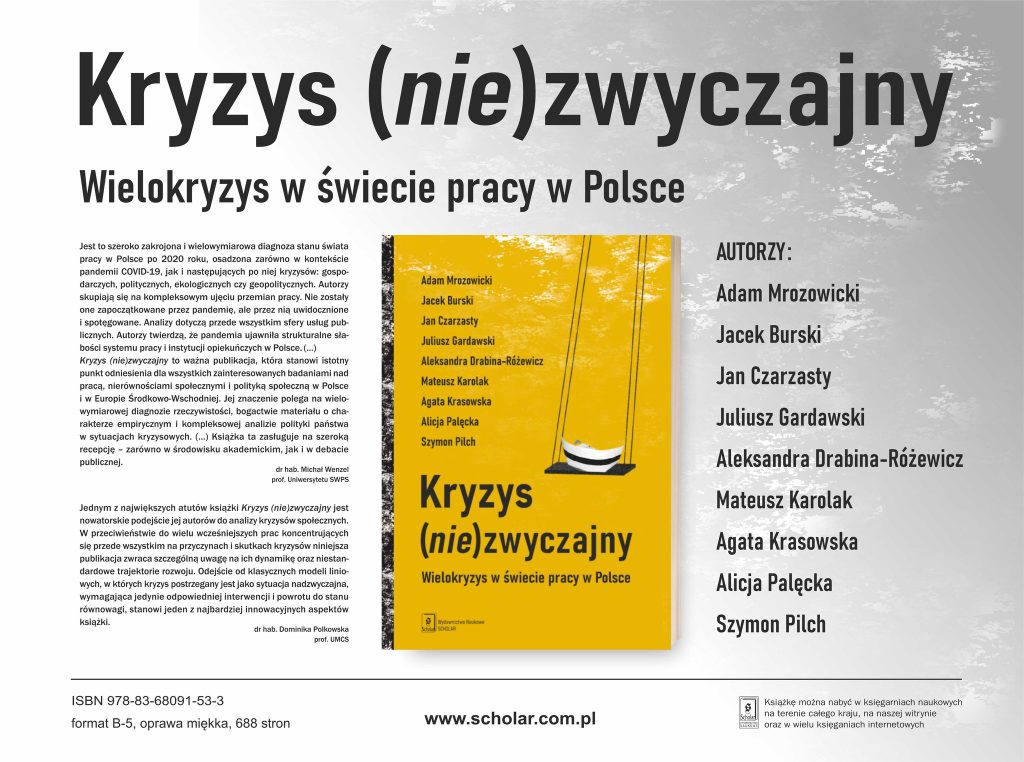
We attempt to answer these questions in a book that is the result of several years of qualitative and quantitative research conducted as part of the COV-WORK project. The monograph “An (un)usual crisis. A Multi-Crisis in the World of Work in Poland” has just been published by Scholar Publishing House, and its authors are: Adam Mrozowicki, Jacek Burski, Jan Czarzasty, Juliusz Gardawski, Aleksandra Drabina-Różewicz, Mateusz Karolak, Agata Krasowska, Alicja Palęcka and Szymon Pilch.
Starting from a study of the (post)pandemic crisis, we looked at other intertwining crises (including inflation, war, refugees and energy) from various perspectives. We conducted a nationwide survey in two waves (2021 and 2023), a series of biographical and expert interviews, and focus group studies with people working in schools, hospitals, social welfare homes and logistics, and finally, a discourse analysis using the latest tools for mass data analysis.
The research confirmed that the social upheavals after 2020, including primarily the COVID-19 pandemic and the full-scale war in Ukraine, highlighted chronic crises in the sphere of work and social reproduction (including unpaid care and public services) and deficiencies in the functioning of the state in the area of anti-crisis policies. These ‘extraordinary’ crises have intensified the everyday problems of low-quality jobs experienced by workers in key industries, which have been overlooked in media discourse and which we have traced back to long-term processes of radical marketisation (liberalisation and partial privatisation) of public services.
In the book, we argue that in the face of sudden crises after 2020, institutional inconsistency (the coexistence of diverse ‘rules of the game’) and the weakness of formal institutions (including the ineffectiveness of the state) in Poland, which we associate with the ‘patchwork’ model of capitalism, triggered spontaneous, grassroots adaptation strategies. These were based predominantly on mutual aid in small groups at work and outside of work, and much less frequently on contestation. In other words, although Poles protested in 2020, this rarely took place in their workplaces, and grassroots employee innovations were crucial to maintaining public services amid the organisational chaos of the first months of the pandemic and the war in Ukraine.
So, did the crisis after 2020 radically change the world of work in Poland? Although most of the people we surveyed shared the belief that we are living in times of multiple crises, their ways of operating in the world of work, their assessments of job quality, and their views on the economy and society have changed relatively little over the past few years. The multiple crises did not lead to revolutionary changes, but at most to transformational ones – it was a reconfiguration, not a revolution in the world of work. A number of innovative employee practices in the face of crises, which we documented in the book, did not translate into institutional reforms and a clear improvement in working conditions. The extraordinary crises after 2020 have therefore been largely “normalised”, fitting into a long-term trend of taming various social and economic shocks in Polish society.